


Marc Faber, publisher of the Gloom, Boom and Doom report, yesterday reiterated his criticism of money printing practices, which he believes will continue in the US, Europe and elsewhere, causing bubbles such as those seen in the Chinese real-estate market.
“A third wave of quantitative easing by the US Federal Reserve is just a matter of time,” said Faber, a contrarian investor who has been referred to as “Doctor Doom” for a number of years.
Printing money is the way global governments will evade debt crises, such as the one that is gripping Europe, Faber said in Taipei.
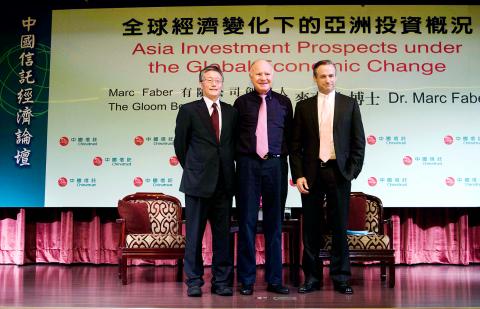
Photo: CNA
That would forestall the crisis rather than solve it, keeping prices elevated for assets like stocks, real estate in some areas and precious metal, he said.
Loose monetary policies, including low interest rates, intended as a short-term fix, can have unintended consequences later, Faber said.
While central banks can inject fresh funds into the markets, they cannot control where the funds flow, he said, adding that money printing has encouraged speculation on commodities whose prices have gone up faster than real demand in recent years.
“Some people will benefit from money printing that deflates the purchasing power of currency ... but the middle and lower--income classes are being hurt,” said Faber, an investment adviser focused on value investments, who owns Marc Faber Ltd.
Countries with resources are basking in the trend in light of their sharp increases in international reserves, which Faber said was symptomatic of monetary inflation and a shift in wealth.
The fast-growing economy of China has pushed up its inflationary pressures, with the bubble in the real-estate sector on the brink of bursting, Faber said.
“Don’t believe China’s consumer price index stands only at 5 percent,” he said. “The truth is somewhere between 12 percent and 15 percent ... The real-estate bubble is so evident that Chinese property shares are very weak as the volume of real-estate transactions goes down and prices fall.”
Faber said China would follow the practice of quantitative easing if it has to choose between printing money and a concrete recession.
The Chinese bubble will burst eventually, in three months or in three years; when it happens, it will have devastating consequences for the global economy, he said.
“Chinese invented paper. They know how to print money,” Faber said.
Still, the ongoing shifting balance of economic power from industrialized countries to emerging economies is building up geopolitical tensions, especially in the Middle East and Central Asia, he said.
All the West needs to do to contain China is seize control of oil supplies, but China and the countries dependent on oil imports would not allow that for the sake of self-preservation, Faber said.
He recommended risk diversification against the current backdrop, but took a dim view of government bond purchases as they would mean trust in the easy monetary policy.
Rather, he suggests owning physical gold, equities and Asian real estate that will prove a better defense against inflation.
Greece, Faber said, is bankrupt whether Europe likes to admit it or not, and the European Central Bank will print money to postpone a systematic failure.

KEEPING UP: The acquisition of a cleanroom in Taiwan would enable Micron to increase production in a market where demand continues to outpace supply, a Micron official said Micron Technology Inc has signed a letter of intent to buy a fabrication site in Taiwan from Powerchip Semiconductor Manufacturing Corp (力積電) for US$1.8 billion to expand its production of memory chips. Micron would take control of the P5 site in Miaoli County’s Tongluo Township (銅鑼) and plans to ramp up DRAM production in phases after the transaction closes in the second quarter, the company said in a statement on Saturday. The acquisition includes an existing 12 inch fab cleanroom of 27,871m2 and would further position Micron to address growing global demand for memory solutions, the company said. Micron expects the transaction to
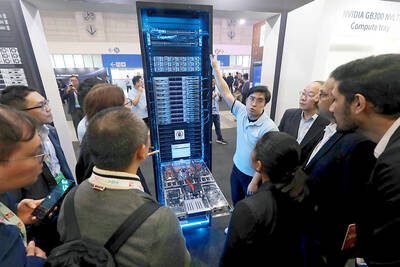
Nvidia Corp’s GB300 platform is expected to account for 70 to 80 percent of global artificial intelligence (AI) server rack shipments this year, while adoption of its next-generation Vera Rubin 200 platform is to gradually gain momentum after the third quarter of the year, TrendForce Corp (集邦科技) said. Servers based on Nvidia’s GB300 chips entered mass production last quarter and they are expected to become the mainstay models for Taiwanese server manufacturers this year, Trendforce analyst Frank Kung (龔明德) said in an interview. This year is expected to be a breakout year for AI servers based on a variety of chips, as
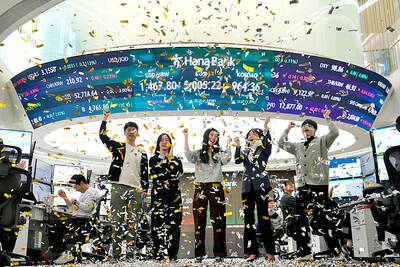
Global semiconductor stocks advanced yesterday, as comments by Nvidia Corp chief executive officer Jensen Huang (黃仁勳) at Davos, Switzerland, helped reinforce investor enthusiasm for artificial intelligence (AI). Samsung Electronics Co gained as much as 5 percent to an all-time high, helping drive South Korea’s benchmark KOSPI above 5,000 for the first time. That came after the Philadelphia Semiconductor Index rose more than 3 percent to a fresh record on Wednesday, with a boost from Nvidia. The gains came amid broad risk-on trade after US President Donald Trump withdrew his threat of tariffs on some European nations over backing for Greenland. Huang further
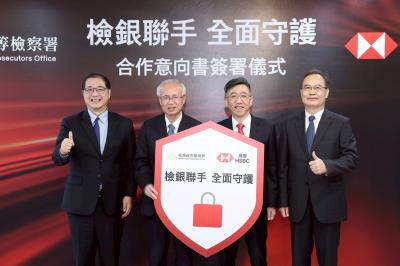
HSBC Bank Taiwan Ltd (匯豐台灣商銀) and the Taiwan High Prosecutors Office recently signed a memorandum of understanding (MOU) to enhance cooperation on the suspicious transaction analysis mechanism. This landmark agreement makes HSBC the first foreign bank in Taiwan to establish such a partnership with the High Prosecutors Office, underscoring its commitment to active anti-fraud initiatives, financial inclusion, and the “Treating Customers Fairly” principle. Through this deep public-private collaboration, both parties aim to co-create a secure financial ecosystem via early warning detection and precise fraud prevention technologies. At the signing ceremony, HSBC Taiwan CEO and head of banking Adam Chen (陳志堅)


 RSS
RSS